The Last Dress Code We Agree On: What American Funeral Clothes Still Get Right
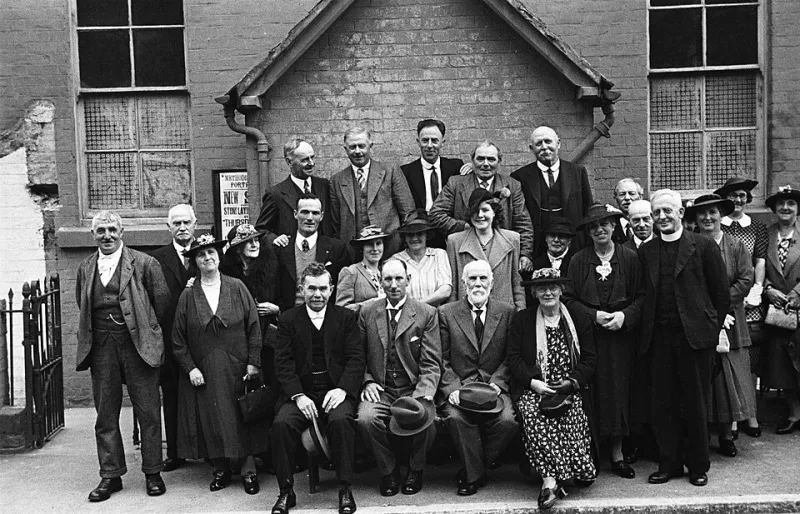
Photo: Geoff Charles, CC BY-SA 4.0, via Wikimedia Commons
There are almost no dress codes left in America that everyone agrees on. Weddings splinter into cocktail, garden formal, black tie optional, and 'wear whatever, we're in a barn.' Offices gave up. Airports gave up years ago.
Funerals are the holdout.
Walk into a funeral home in almost any American town and you'll see a room in near-unison: dark suits, dark dresses, muted ties, closed-toe shoes, very little jewelry, and a whole lot of people who clearly own one outfit for this. That consensus is remarkable, and it's not really about fashion. It's about signaling.
Why black still works
Black isn't a rule in America so much as a habit with good instincts behind it. It's visually quiet, it photographs without distraction, it flatters almost everyone, and — crucially — it recedes. At a funeral, nobody is supposed to be looking at you. Black makes that easy.
Navy, charcoal, dark gray, and deep green or burgundy all do the same job. The point isn't the specific color. It's that the outfit stays out of the way of the grieving family. Any dark, simple, well-kept clothing satisfies that.
What you're avoiding is contrast with the occasion: bright prints, logos, athleisure, anything that reads as a joke or a statement, anything you'd wear to a party. Modesty matters too — covered shoulders, longer hems, nothing tight or low-cut. Not because grief has a hemline, but because the room is full of someone's grandmother, and the standard is respect.
The regional and religious map
There is no single American funeral, and the dress shifts with the tradition.
Catholic funeral Masses tend to be the most formal: dark suits, dark dresses, modest necklines, sometimes a veil for those who wear one. Protestant services, especially in the South, run similar but slightly looser — a dark dress with a cardigan is fine, and in summer heat you'll see plenty of women in sleeveless dark dresses with a light wrap for the church.
Jewish funerals and shiva are typically less formal than the funeral home standard, and the emphasis is on presence rather than presentation. Dark or muted clothing, modest cuts, no flashy jewelry. Some mourners wear a torn ribbon or black ribbon pin; you don't need to replicate that, but you shouldn't wear anything that clashes with it. If you're visiting a shiva house, skip the flowers and bring food.
Muslim funerals call for modest, conservative clothing — dark or neutral, long sleeves, long hems, and for women often a headscarf at the mosque, though you should ask if you're unsure. Shoes come off in prayer spaces, so wear something easy to slip out of.
Celebration-of-life services are the wild card. Families increasingly request color, or 'bright and cheerful,' or the deceased's favorite team jersey. If they've said so, honor it — that's not a loosening of the code so much as a new one, written by the person closest to the loss. Where it gets awkward is when a celebration-of-life invitation says nothing at all. In that case, default to dark and add one small bright note — a scarf, a tie, a piece of jewelry — so you're covered either way.
The inherited piece
There's a custom that hasn't died, and it may be the best thing about funeral dressing: wearing something of the person you lost. A tie, a pair of earrings, a watch, a brooch, a scarf. It doesn't have to be black. It doesn't have to be expensive. It just has to be theirs.
This is the one place in American fashion where an old, slightly out-of-date object is not a faux pas but the point. Nobody looks at a 1970s watch at a funeral and thinks 'that's dated.' They think 'that was his.'
If you didn't inherit anything, that's fine too. Wearing a color they loved, or a piece that reminds you of them, does the same work.
What to skip
- Strong fragrance. Rooms are close and people are crying. Keep it minimal or skip it entirely.
- Brand-new shoes. Graveside services involve standing on grass, gravel, or uneven ground. Comfort beats polish every time.
- Anything you have to adjust all day. You'll be hugging people, sitting in pews, standing in lines, and possibly carrying food.
- Jewelry that clinks or catches light. A watch, small earrings, and a single ring are plenty.
- White, unless you know the family's tradition. It can read as celebration in one context and as a misstep in another.
Assembling it without shopping
Most people already own a funeral outfit; they just call it their interview outfit or their nice-wedding outfit. A dark suit and a dark tie. A black midi dress and a cardigan. Dark trousers and a simple blouse. If you have a navy or black anything with a modest cut and a pair of plain closed-toe shoes, you're done.
If you don't, don't buy a new wardrobe for one afternoon. Thrift a dark blazer that fits your shoulders, borrow from a friend, or pick up one dark dress you'd genuinely wear again at a holiday party or a work dinner. Funeral clothes are the most reused clothes in America — the same black dress shows up at wakes, concerts, and New Year's Eve for a decade. That's not grim. That's efficient.
The point of it
What makes funeral dress the most honest fashion ritual we have left is that it asks almost nothing creative of you. There's no self-expression contest, no fit check, no one trying to look interesting. The outfit's entire job is to say 'I'm here, I'm not the story, and I'm paying attention.'
Most dress codes are about fitting in or standing out. This one is about the family in the front row. That's a low bar to clear, and somehow it's also the highest standard American style still manages to meet.